

The traditional approach to conference sponsorship follows a familiar sequence. You have an event, a prospectus, and a pipeline. It used to be enough. But as competition for sponsor attention, budget and time intensifies, a top-down model is starting to show its limits.
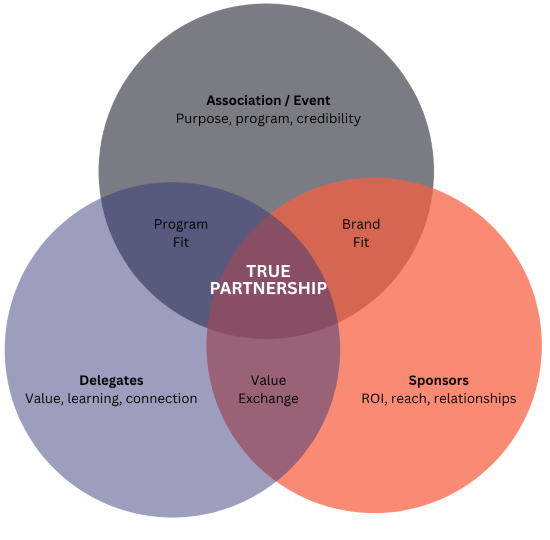
The better model isn’t a pipeline. It’s a Venn diagram.
Three distinct parties sit at the table whenever sponsorship is involved: the association or organising committee, the sponsors themselves, and the delegates. Each has their own set of interests. Each is there for different reasons. The quality of a sponsorship program is determined, more than anything else, by how much genuine overlap sits in the middle.
Want to find the overlap in your sponsorship program? Get in touch with Matthew Phelps at matthew@theassociationspecialists.com.au
What Each Party Actually Wants
Associations and organising committees are protective of two things above all: the credibility of the event and the trust of their members. A sponsor who undermines either of those, even inadvertently, damages the event and the relationship with an audience the association has spent years building. What they need from sponsors isn’t just funding. It’s alignment.
Sponsors have commercial objectives. They’re not participating out of goodwill; they’re investing in access to a specific audience, in a specific context, with specific outcomes in mind. That might mean brand positioning, lead generation, face time with decision-makers, or getting their product in front of the people who matter most – the end users. Understanding what a sponsor needs to justify their investment is foundational to building a program that retains them.
Delegates are the party most often underserved in the sponsorship equation. They didn’t come to be sold to. They came for the program, the speakers and the hallway conversations with peers they rarely get to see in person. The sponsorship experience will either strengthen that relationship or quietly erode it. Done well, it elevates the whole experience. Done poorly, delegates and associations alike feel it.
The Direction of Fit
The natural way to read the Venn diagram is top-down: the event defines what’s on offer, and you find sponsors who want it. That’s the prospectus approach, and it works to a point.
The most productive matches happen when you read the diagram in all directions at once. It’s not just “does this sponsor fit our event?” It’s also “does this event deliver what this sponsor actually needs?” And more importantly: “will the people in that room find genuine value in what this sponsor does?”
A sponsor can be well-aligned with an event on paper, right sector, right brand positioning, appropriate level of investment, but completely wrong for the delegates. A supplier with no product relevance to the clinical specialty in the room is there for awareness, not for the people attending. That creates a friction the delegates feel, and the sponsor usually notices when the engagement doesn’t materialise.
The same logic applies in the other direction. An event can be too focused on protecting the delegate experience that sponsor activations get watered down to the point of being pointless. A sponsor who can’t make a meaningful connection with the audience hasn’t been given what they paid for. That’s not protecting delegates. That’s a poorly designed program.
Matching As a Craft
Finding the right sponsor for a specific event is different work from filling a prospectus. It means knowing the delegate community well enough to ask: would these people find value in engaging with this company? And it means understanding a sponsor’s objectives honestly enough to know whether this event can realistically deliver them.
Sometimes the honest answer is no. A sponsor with a strong consumer brand looking for mass reach is probably not the right fit for a specialist professional conference with four hundred attendees and a tight clinical focus. Sometimes the most valuable thing you can do is say no and redirect them toward a suitable alternative. That honesty builds lasting relationships. When the fit is right, the activation design almost writes itself. The sponsor’s subject matter connects to what delegates are there to learn. The conversation that happens at the booth, the session, or the lunch table adds something to the delegate’s day rather than interrupting it. The association can point to the sponsorship as a genuine enhancement to the program.
What This Means for Retention
Retention strategies are often framed as something you implement after the event: reporting, relationship management, early renewal conversations. Those things matter. But they’re most effective when the underlying fit was right to begin with.
A sponsor who found the right room, had real conversations, and saw genuine engagement from delegates doesn’t need a convincing renewal pitch. The experience made the case. Conversely, no post-event report, however well-produced, fully compensates for a sponsorship that sat outside the Venn. The relationship survives a year on goodwill, maybe two, but it doesn’t grow.
The commercial reality is that retained sponsors are worth significantly more than new ones. They require less onboarding, carry more credibility with the delegate community, and are more likely to increase their investment over time when the returns are there to justify it. But the foundation for retention is laid before the event, in the matching work and built on afterwards by staying curious, listening to feedback, and being willing to adapt entitlements to keep the relationship fresh and find new ways for sponsors to engage.
Where TAS Fits In
Sponsorship programs that hold up over time are built on fit, not just inventory. The matching work, understanding a sponsor’s real objectives, knowing the delegate community well enough to predict where value lands, designing activations that earn their place in the program, is where the difference between a one-year sponsor and a five-year partner gets made.
That’s what TAS brings to every event we manage. We’re deliberate about who’s in the room, why they’re there, and what a successful outcome looks like for everyone involved. If your current sponsorship program is running but not growing, it’s worth asking whether the fit was right to begin with and whether the value being offered is packaged in a way that lands for sponsors and delegates alike.